< news
Porto sets the scene for Portuguese–Brazilian encounters in “O Pecado Mora em Cima”
Miguel Falabella, Marisa Orth, Inês Aires Pereira and Pedro Carvalho star in the comedy O Pecado Mora em Cima, directed by Rui Pedro Sousa, which opens in Portuguese cinemas this Thursday, 15 October. Produced by Sónia Resende, the film was shot at several iconic locations in Porto, with support from Filmaporto.
Two couples, one Portuguese and the other Brazilian, separated only by thin walls and brought together by a succession of misunderstandings, desires and prejudices, provide the starting point for this comedy of manners, which brings Brazilian actors Miguel Falabella and Marisa Orth together with Inês Aires Pereira and Pedro Carvalho.
With a screenplay by Edson Athayde and cinematography by Pedro Negrão, the film is based on The People Upstairs, by Spanish director Cesc Gay, adapting the story to Portuguese life and the relationship between Portugal and Brazil.
The project began as an initiative by producer Sónia Resende, who negotiated the rights to the original work, assembled the cast, chose the soundtrack and put together the financing needed for the production. “It all began with a question I asked myself as a producer: if this story was already being adapted in several countries, why should there be a Portuguese version, and how could I still bring something new to it?” she explains.
The answer lay in finding an identity of its own for the adaptation. “I liked the premise, the intelligence of the dialogue and, above all, the opportunity to use comedy to talk about subjects that can become very heavy outside that context: the wear and tear on relationships, desire, sexuality, routine, prejudices and what we hide even from the people we live with,” adds Sónia Resende.
O Pecado Mora em Cima marks the first time Miguel Falabella and Marisa Orth have worked on a film in Portugal. For Sónia Resende, casting the Brazilian actors also offers a way of bringing different audiences together. “Several generations, including in Portugal, grew up watching them. They both also have something particularly interesting for this film: an enormous talent for comedy without losing the humanity of their characters,” she says.
Inês Aires Pereira and Pedro Carvalho bring to life a Portuguese couple from a different generation, with “a different energy and a different way of being”. Bringing the four actors together ultimately shaped much of the film’s personality.
The Brazilian presence in Portugal is explored through humour, without turning cultural differences into a contest between nationalities. “The first rule was never to make jokes at the expense of a nationality. Our humour comes from what happens when these people meet, from their assumptions about one another, from the words they interpret differently and, above all, from their own prejudices,” explains Sónia Resende.
For the producer, comedy allows sensitive issues to be approached with less defensiveness. “Sometimes, through laughter, we can recognise something we would immediately reject if someone lectured us about it.”
Nationality thus becomes a starting point for more universal themes. “Ultimately, nationality opens the door to a much more universal question: how much of what we think about others actually says more about ourselves?” she asks.
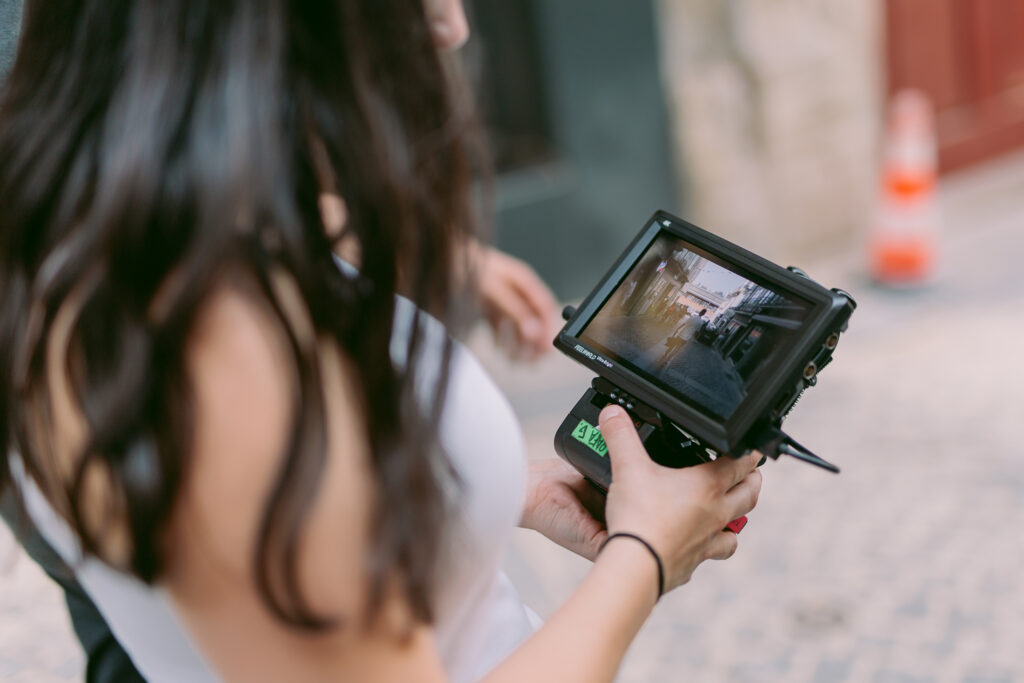
Although much of the action takes place inside the protagonists’ home, built from scratch in the studios of RTP’s Centro de Produção do Norte (Northern Production Centre), Porto is present throughout the film. Filming took place at locations such as Rua das Flores, Livraria Chaminé da Mota, Praça de Parada Leitão, near the Reitoria da Universidade do Porto (University of Porto Rectorate), and Rua de Alexandre Herculano.
The aim was not simply to create a tourist postcard of the city. “When we left that house, we wanted it to be clear that these characters really do live in Porto, rather than in an unspecified Portuguese city,” says Sónia Resende. “We didn’t want to make a tourist postcard of Porto. We wanted Porto to be the city where this story takes place,” she adds.
The connection with the city also extends to the production. “We are a production company from the North and wanted to make a feature film of this scale here, also drawing on predominantly local facilities and professionals.” So, for Sónia Resende, Porto is not exactly a character in the film. “It is these characters’ home. And in a film that talks so much about what a home means, that also takes on a special significance on a metaphorical level.”
Music also plays an important part in this comedy’s identity. The soundtrack includes landmark songs from the Portuguese-speaking world, such as “Fado Tropical” by Chico Buarque, “A Minha Casinha” by Milú, and “Vou Dar de Beber à Dor”, made famous by Amália Rodrigues. The film also features original music and a performance by the Orquestra da Academia de Música de Vilar do Paraíso (Vilar do Paraíso Music Academy Orchestra).
“Music was one of the ways I found to give the film a Portuguese identity with a strong emotional resonance,” explains the producer. One of the reference points is O Costa do Castelo, a classic of Portuguese cinema that Sónia Resende remembers particularly for the scene featuring “A Minha Casinha”, performed by Milú.
The choice took on a special significance when Sónia Resende discovered that Miguel Falabella also counted that classic among his reference points in Portuguese cinema. “Even before this film existed, there was already a cultural memory that connected us — me being Portuguese and him Brazilian,” she says.
The film is directed by Rui Pedro Sousa, with whom Sónia Resende had previously worked on Blood(less) Revolution, one of the most-watched Portuguese films in cinemas in 2024. In this new project, his second feature film, the director adopts a comic register different from his previous work, combining the story’s theatrical rhythm with a contemporary cinematic language.
O Pecado Mora em Cima opens this Thursday, 15 October, in Portuguese cinemas, distributed by Cinemundo. The film will also be distributed internationally, with a particular focus on Brazil and countries with sizeable Portuguese-speaking communities.